Intraplex
Law firms, hospitals, defence suppliers and offshore operators mostly can't use AI at all, because their files aren't allowed to leave their network, and that rules out every hosted assistant. Intraplex runs on open models inside their own perimeter: ask across everything they own, get cited answers and real documents back, with the internet physically unplugged if that's the requirement. About an eighth of what the cloud equivalents cost.
- 1M+
- documents supported
- 11+
- systems connected
- ~1/8th
- the cost of cloud
What the problem was
The organisations with the most to gain from AI are usually the ones barred from using it. A hospital holding patient records, a firm holding privileged work product, a defence supplier, a bank under SOX and GLBA, sending files to someone else's servers isn't a preference to weigh up. It's simply not allowed.
The workarounds on offer don't hold. Bringing your own key to a cloud vendor still means your data crosses their infrastructure. Enterprise search has the connectors and the governance but treats AI as a bolt-on, so it stumbles on tables, charts and anything scanned. Self-hosted open-source stacks can technically run on your hardware, but arrive with no audit, no access control, no retention, and a large integration bill. And most “on-prem AI” products quietly fall over somewhere around twenty thousand real documents. Intraplex is built for more than a million.
So these organisations carry on the old way: people searching by hand through decades of files, slowly forgetting what's in them.
How I built it
Open models, running on their own hardware
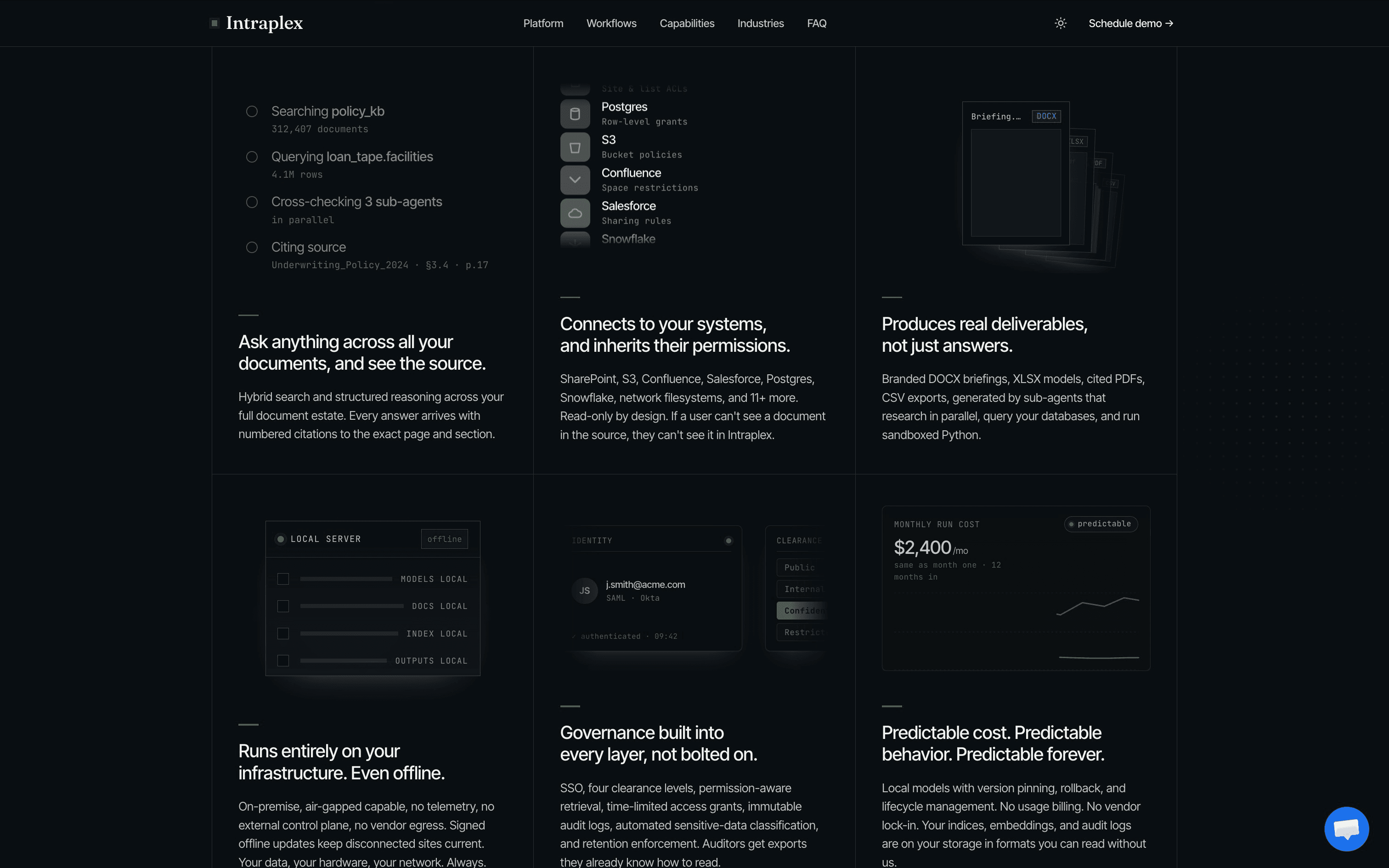
Everything runs on open models the customer hosts themselves. That single decision is what makes the rest possible. There's no vendor control plane, no telemetry, and no outbound connection to disable, because there was never one to begin with.
Air-gapped sites stay current through signed update bundles rather than a network call. Models are version-pinned and can be rolled back, so behaviour doesn't change underneath a validated process. Indices, embeddings and audit logs sit on the customer's own storage in formats they can read without me, which also means there's nothing to be locked into.
Governance that goes well past access control
Every connector is read-only and inherits the permissions that already exist: SharePoint site and list ACLs, Postgres row-level grants, S3 bucket policies, Salesforce sharing rules, Snowflake role hierarchies. Trimming happens at retrieval, so the model is never shown a document the person isn't cleared for and it can't leak through a summary either.
Above that: single sign-on, four clearance levels, an immutable audit log of every search, query and tool call, automatic classification of sensitive material across seven categories, and retention rules that purge on schedule.
The part I'm most pleased with is what happens at the boundary. Ask for something above your clearance and the system tells you the document exists without revealing anything about it, then lets you request access, which a partner approves for 7, 30 or 90 days with a note attached. The grant expires on its own, so nobody accumulates permissions they've forgotten they have.
The answer is rarely the deliverable
Real work ends in a document, not a chat message. Sub-agents research in parallel, query the databases directly, run sandboxed Python, and produce the actual artifact: a branded DOCX briefing, an XLSX model, a cited PDF, a CSV an auditor already knows how to read, with the references carried through into the file.
A commercial loan analysis is the clearest example. It used to take an analyst about six hours: read the underwriting policy, pull the loan tape, dig financials out of embedded spreadsheets, write the credit brief. It now comes back in roughly thirty minutes, with every figure traceable to a page. The audit log shows exactly which sources and queries produced it, including the privileged matter it was refused access to along the way.
Five very different rooms, one product
Financial services run covenant and credit analysis across policy documents and loan databases together, under SOX, FINRA and GLBA.
Healthcare and life sciences get PHI-safe answers over SOPs, CAPAs, batch records and validations, with HIPAA and GxP obligations handled by classifying and logging rather than blocking the conversation.
Public sector and defence run fully sovereign, with no external dependencies, complete functionality offline, updates arriving through internal mirrors.
Legal teams search hundreds of thousands of documents scoped to the matters they're on, while privileged sibling matters stay genuinely invisible.
And edge operations run on one machine in places with no connection at all.
Shipping AI to an actual ship
An offshore vessel runs the whole thing on a single RTX-class server with no satellite uplink. The maintenance crew photographs a scanned engineering schematic, asks what it means, and gets a cited answer with the relevant page of the equipment manual alongside it. When the vessel reconnects, signed updates apply on schedule.
Offline isn't a degraded mode there, it's the design, which is the same reason it suits mines, field sites and secure rooms. Twenty-three sessions in a day, zero cloud calls.
How it turned out
- Handles more than a million documents: real, mixed-quality archives, not curated demo sets.
- Connects to 11+ document and database systems at once, querying databases in place rather than copying them into a second source of truth.
- Deploys three ways: the customer's own cloud tenant, their datacentre from a single GPU up to a multi-rack cluster, or one server at the edge.
- Runs genuinely disconnected. No telemetry, no control plane, nothing phoning home.
- About $2,400 a month against $18,400+ for the cloud API equivalent, flat rather than per-use, and the same in month twelve as in month one.